Thursday, 31 January 2013

Dutch Scale Seven Group report nr. 14

For the last Scale Seven Newsletter we had not submitted our latest update you so here is a new report  from the DSSG. There are some projects we are working on that are making progress and still go on with the scale seven promotion in the Netherlands.

At the Dutch 0 gauge weekend held last October in Zutphen we had a little stand with some  scale seven model engines. Cor gave a demonstration with his GWR 0-6-0 Saddle tank which he had converted from fine scale into scale seven. In this major rebuild the loco also got a DCC decoder and working CPL head lights. We demonstrated a rebuild loco with an inside motion and a very smooth running at the test track. Ton came with his beautiful 517 Class and his Pannier. Both engines were finished and ready to run on his “Tripton at Sea” railway.

For the promotion of scale seven in the Netherlands the DSSG is invited to set up the promotion stand at Rail 2013 in Houten, a small town near Utrecht. This exhibition will take place at 22, 23, and 24 February in the Eurector-Expo-Center in Houten. At this exhibition the complete scale seven layout “Tripton at Sea” will be shown for the first time fully in operation for the public. Ton Trip, the proud owner of this layout, has finished his engines and wagons so he can demonstrate a layout build using the scale seven standards. Cor will also demonstrate his scale seven models at this layout such as the GWR 0-6-0 Saddle tank with complete working inside motion. Ton’s GWR 0-6-0 Pannier tank also has a working inside motion. The Dutch modellers at the show are always interested in our way of building models.

In our promotion stand we will show some models we are working on. GWR 0-6-0 Dean Goods, GWR 2-4-0 3500 Stella class under construction, Broad Gauge G.W.R 0-6-0 Armstrong Goods, a convertible engine and the beautiful BG Rover Class. Some wagons, BG coaches and the Cowan Sheldon railway crane. At the displays we will also put some Dutch wagons build by Cor in the scale seven standards. This is unusual in the Netherlands because all the Dutch 0 gauge modellers use fine scale standards. But we will show that it’s also easy to build a finescale designed Dutch wagon kit in the scale seven standards.

In the last months we were busy with building some models.
The Minehead 1900 – 1910 railway is progressing slowly because of lack of time and the son of Cor who is building every Wednesday night at the Minehead railway was abroad for study during 10 weeks. But for this railway Cor build two Iron Minks and finished the Iron Cattle wagon. He also started to build two GWR Two Planks. For the Iron Minks and the Two Planks he used WEP kits and build all these wagons in the old version with grease bearings and a break on one side. The wagons are finished now and lettering is the last step to do in the  coming weeks.

Cor also started to build the GWR 2-4-0 Stella class. For this model he bought the M. Finney kit complete with a 2500 Gallon tender. An ABC gearbox with a Maxon motor will be used as the power source to get a smooth and realistic running engine. The wheels came from Slater’s and will be turned into scale seven standards by Cor.  He chose to build the roundtop version with the S4 boiler and a complete working inside motion.

For the Broad Gauge railway Kingswear Cor ordered from the Broad Gauge Society the G.W.R  2-4-0 William Dean 3501 Class. The BGS produced a kit for members of this Broad Gauge engine. This engine will be build in scale seven like all the other BG stock on this railway.  A nice kit to build was the Old Mink. This kit is also a product of the BGS. The body is CNC milled from Plasticard. The construction of the frame and compensation must be designed by the builder. Cor made an inside compensation and placed rivets in the body. These small rivets came from the German company GHW. Cor drilled the holes and glued the rivets into the small 0,6 mm holes. In the whole body Cor used 330 rivets. 


The broad gauge Kingswear  railway is setup in the workshop of Cor to look at it and when there is more time make progress and finish some parts. 

Some pictures of the Kingswear Broad Gauge Railway.
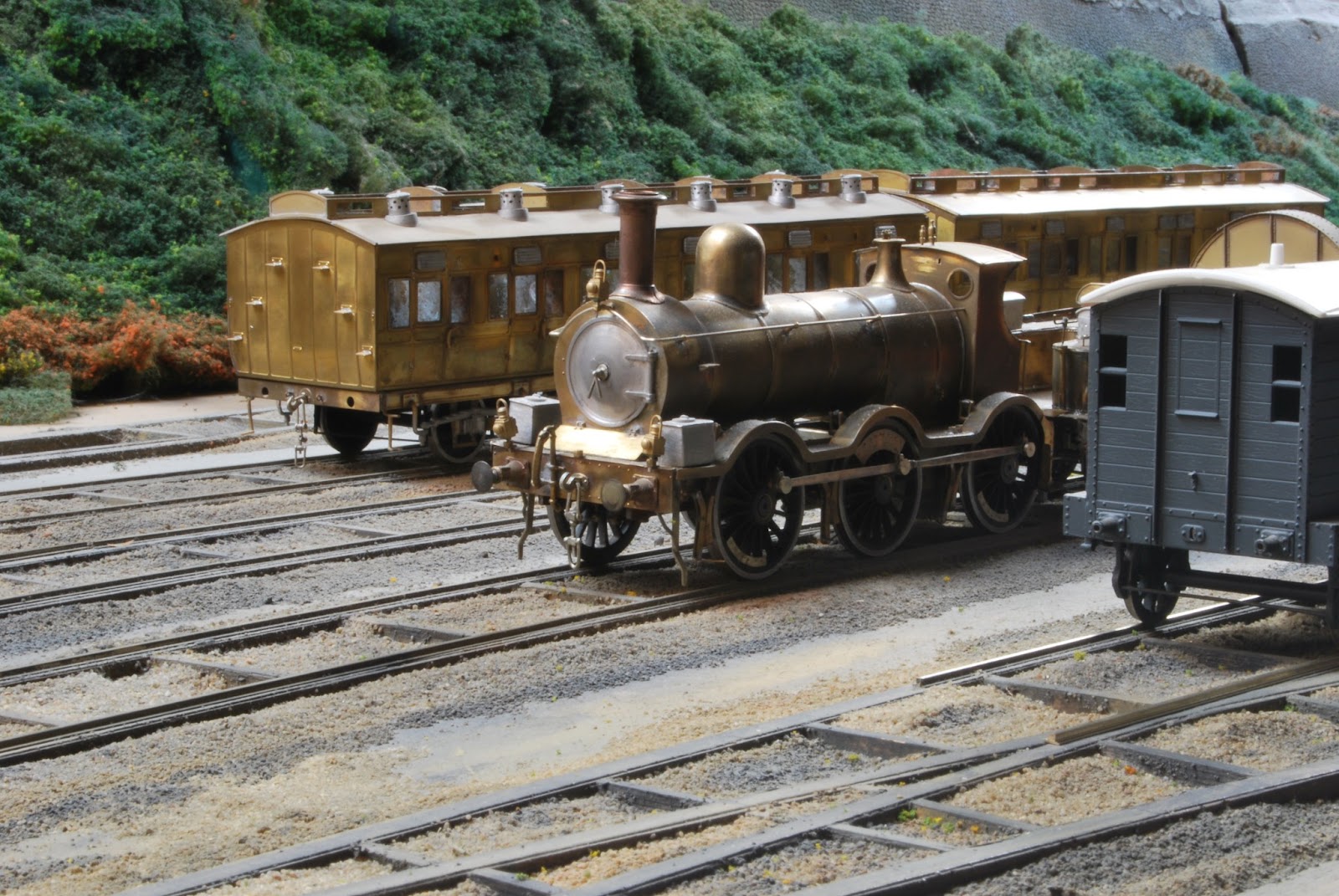
View at the yard. 

Unloading the wagens in the goods yard. 
Till next, Cor 


Saturday, 7 July 2012

Dutch Scale Seven Group report nr. 13


After some months of silence here a new report  from the DSSG. There are some projects we are working on and that are making progress.

A small project was the rebuilt of a finescale GWR 0-6-0 saddle tank to the S7 standards. The kit was not designed for S7 standards so we had to change the measurement of the splashers on the footplate. We turned wheels into the S7 standard and replaced the first and third axle with a S7  axle and modified the power pickups. The middle axle with the inside motion was reused and we used Slaters’ filler rings to get the correct S7 back to back measurement. After this rebuild the engine was converted to DCC with a Lenz  DCC decoder. A challenge was to make the CPL GWR loco lights working. With a small SMD led fitted into the small brass CPL casting we got a working loco light. For this fine work you need to work with a magnifier to solder the small thin wires on to the 1mm x 1,2mm x 2mm SMD led. The CPL loco lights are relatively simple to convert into a working light.


CPL loco light housing, lens and very small SMD Led.

GWR 0-6-0 Saddeltank 2028 with working light.
In the GWR 0-6-0 Dean Goods Cor installed an ESU sound decoder with ESU power pack and speakers. After an experiment to find out what the best place will be for the location of the speakers we came to the conclusion that the best place is one speaker in the smoke box and one speaker between the frame plates. Important is a open chimney so you can hear the exhaust sound through the chimney. There is no speaker in the tender. In the tender we mounted the sound decoder and the power pack. The connection to the engine is made with an small 22 pins connector so the tender and engine can be separated very easily. For the synchronisation of the movement from the inside motion with the exhaust sound we will place 4 very small magnets in the big tooth wheel which is mounted on the axle in the ABC gearbox. An electronic Hall censor will pick up the change of the magnetic field and give synchronisation signals to the ESU sound decoder. For the sound we chose the SWD Pannier sound. There is no sound for a GWR 0-6-0 Dean Goods available. At the GOG 2012 Summer show in Halifax  Arnold and Cor spoke to an expert in DCC sounds and he told us the Pannier sound is the most nearby and so suitable as a Dean Goods sound.

ESU sounddecoder build in Dean Goods tender.
 The construction of the home Scale Seven layout  “Minehead” of Cor and son Joost is going forward with small steps. We produced a lot of wooden sleepers for the tracks and a lot of wooden sleepers with different measurements for the points. For the shape of the points we used the printed point drawings produced with the Templot track design program. A small part of the track is ready and connected to the Lenz DCC control system. The rebuild GWR 0-6-0 2028 Pannier tank was the first engine to run a few meters on the new Scale Seven layout “Minehead”.

GWR 0-6-0 Dean Goods at S7 point.

Joost building S7 track at the  "Minehead"railway.
 Arnold is busy building a piece of G.W.R Baulk road to display his future engines. After the conversion from broad gauge to standard gauge there was a lot of converted track in use at the stations and sidings. For this piece of display track Arnold will also place the square head bolts to make this track the most prototypical. It’s not an easy task but Arnold will pick up the challenge. When he has finished we will take a picture of his work and send it with the next DSSG report.


G.W.R Baulkroad.

Till next, 

Cor

Sunday, 1 January 2012

Dutch Scale Seven Group report nr. 12

We had a busy time the last 4 months of the year 2011 which is why we didn’t have a report in the last S7 Newsletter.

But now there is time to write down all the progress and special things we did.
At two modelling shows we did set up the Scale Seven promotion stand. In October at the Dutch Nul weekend in Zutphen for two days where we had a lot of talk with serious 0 gauge modellers but they are still afraid to take a step forward to the Scale Seven standards. But we enjoyed the show and had a good time. This meeting is the only meeting for the Dutch 0 scale modellers. The second show where we set up our stand was the 0 weekend in Belgium. The Belgium 0 forum organized this small 0 Gauge show and we promoted the Scale Seven standards there on a Saturday. But the same as in the Netherlands the Belgium modellers stay where they are with the NEM or Finescale standards. But the promotion board we got from the UK Scale Seven group was an eye catcher at the shows. When everything goes well Ton will show his Scale Seven layout “Tripton at  Sea” at the Dutch Rail 2012 show in February.

Our modelling is going forward with small steps. Ton is hard at work with his GWR 517 Class engine and his GWR 0-6-0 Pannier.


GWR 0-6-0 Pannier detailed cab.
   And Cor did some work at the inside motion of the GWR Pannier tank Ton built.
Inside motion GWR Pannier.

And Arnold made progress with his GWR 'Paco' Horsebox diag. N8. This model is almost finished so Arnold can start with a new project to build. 


GWR 'Paco' Horsebox diag. N8.

Nice details at the doors.
 Cor’s work at the Cowan Sheldon crane is almost finished. At Cor ‘s house the Scale Seven railway is making a lot of progress and the project is still on schedule. At the end of 2011 the first part of the woodwork and wiring is finished and we started to build the tracks. All the tracks must be hand laid. We produce our own sleepers of real wood.

Three stages of track building.

Cowan Sheldon Crane.
The railway is build as a home layout  so we can’t  set up the railway at shows or exhibitions. We made a heavy wooden base with 18mm surface MDF boards as a basis for a strong and steady layout. Under the layout surface we mounted the standard DCC wiring  and in the front the Lenz LA152 connector units.  For the railway bed we used 3,5 mm hardwood multilayer and on the bed we glued the wooden sleepers.

As a prototype we used the Minehead station during the 1900 – 1910 period. A perfect guide to get information about  this station is the beautiful book “The Minehead Branch 1848-1971” .
And certainly we have a lot to do and still some unfinished kits in the drawer but we can’t resist the fine kits offered by the traders. Arnold bought the beautiful MOK Armstrong kit, Cor and Ton bought some kits to build wagons such as Iron Minks, Toads, Scorpion etc. We like modelling with brass so we only bought brass kits.

Till next,

Cor.

Thursday, 17 November 2011

Extra DSSG report: Promoting Scale Seven in Belgium

In the weekend of 26 & 27 November the Dutch Scale Seven Group will have a promotion stand at the Belgium 0-Forum weekeinde.
This is our first step to promote Scale Seven modelling in Belgium.


Location of the exhibition


What  : 0-Forum weekeinde
Where : Ontmoetingscentrum Hofstade
        Zemstsesteenweg 15
        1981 Hofstade (near Zemst)
        Belgium
When  : 26 & 27 November 2011
        Saturday from 11:00 h till 17:00 h
        Sunday from 10:00 h till 16:00 h
Admission: free


Although our apearence there will be only on the Saturday we hope to meet Belgium 0 scale modellers and get them interested in Scale Seven.


GWR Deangoods inside motion build by Cor de Jong

CdJ

Sunday, 17 July 2011

Dutch Scale Seven Group report nr. 11

Our visit at Ton's home on Friday 15th July 2011

As Arnold and Cor thought of visiting their companion in S7, Ton Trip, they chose happily enough their appointment on the only gorgeous summer evening among other rainy days. Although fairly long the trip was very worthwhile. We had set the goal to photograph the progress Ton made on his new bought kit of Mitchells’/JLTRT GWR 517class. Right after their arrival at Ton’s home the model was carried outside to catch it in the last rays of natural light that day.


The weather was so nice it was decided to stay outside and we settled in the garden talking S7 models. Of course the build of Ton’s model was one of the subjects we talked about. We were especially curious after his building experiences with this kit and our conclusion is that it is still very appealing because of its extended range of possibilities to make any version you would like. Above all: the kit contains frame spacers for Scale 7. Ton chose to make a version without the outside axle bearings of the trailing wheel, an open cab, straight coal fender and a round top boiler.
Cor brought his model of the 15t Cowan Sheldon crane from D & S Models and was very much admired for the result he achieved so far. Cor admitted the final state where all kinds of small bits and pieces have to be attached is a slow process. However the scratch build new chimney Cor made on his lathe was something to be proud of. Recognising the model Ton recalled he build one in 4mm scale also from D & S Models and he fetched his smaller version upstairs to compare it on the garden table. Both models need to be married with an appropriate match truck. The crane in 4mm can be supplied with the kit from Brassmasters of a GWR L4 match truck but there isn’t (yet) a kit of a GWR L4 truck to match the 15t Cowan Sheldon crane in 7mm scale. For now a two-plank wagon of Dracon Models will do. We are thinking of making a scratch build L4 match truck for Cor’s crane in the future to make the picture complete.
Arnold showed his progress on his redesigned frame for his Roxey Mouldings kit of the GWR Medium Metro class. The frets of this kit were designed and converted to 7mm scale by Rod Neep more than 25 years ago. Scale 7 was not that much in the picture at that time so obviously this kit contains no S7 frame spacers to suit the frame. Arnold’s desire to build in a working inside motion makes the frame plates which come with this kit even more unlikely useable. Therefore new frame plates complete with S7 spacers will be made.
At the latest G-0-G Summer Show in Halifax Arnold met Peter Silvester who’s also building a GWR Medium Metro from the kit of Roxey Mouldings. Peter gave besides more prototype information and lots of inspiration some detailed pictures of his model in progress. The blown pictures and various details were discussed in humble admiration of this modeller.
Ton unfolded his plans to make a fiddle yard for his (still unnamed) S7 layout. He struggled with the thought how to get rails for this project. A swift explanation how to use aluminium sections for this goal cleared the way to start with this part of his layout. Ton also mentioned to be invited with his layout to attend the next model railway show RAIL.
Before Arnold and Cor left Ton offered the chassis of his failing pannier tank engine for repair. One of the axle ends of this loco came loose from the working inside motion caused by an insufficient soldered joint.
There was so much to talk about but Arnold and Cor had to leave to go home. A long journey back seemed afterwards caused by the delay of traffic jams on road repair. It was a very nice meeting and very worthwhile in spite of the fact we came home around 01:00am.

Till next,

Arnold

Dutch Scale Seven Group report nr. 10

17 July 2011

In this report we inform you  about the start of the Scale 7 layout located in the house of  Cor.
Some weeks ago one of  Cor’s children moved to an apartment in Haarlem. As a result an extra room for railway modeling was created by internally moving furniture in the house. This room is connected with the already existing railway room so there is more space now to set up a model railway. The shape of the two connected rooms is not a normal shape as one of the walls has an angle of 45 degrees. The result of this unusual shape means we can set up a model railway with a length of 14 metres. And we have a space extension in the third connecting room for a fiddle yard with a length of 4 metres. We will set up this fiddle yard extension on the evenings we want to run our trains or on the open days we will plan in the future. But first we need to work hard to set up the layout.

Drawing left side.
  
Drawing right side.


Left side frame construction.
 
 In the third week of June all the basic painting in the rooms was done and we could set up the first woodwork of the new layout. After some discussion we decided to build the baseboards on the height of 1.45 metres. This height creates space under the layout to work easy and serves as a storage place. The height is at eye level so we can see our models in a realistic view.
More daily information about the construction of the Scale 7 railway will be published on the  new DSSG blog.   http://dutchscalesevengroup.blogspot.com

The DSSG members are still busy with their models.
Ton has started to build a 517 Class with a kit from Malcom Mitchell/JLTRT, Slater’s wheels profiled by Christopher Makepeace and an ABC motor and gear. Arnold spent time to collect all these parts for Ton. Some pictures will follow. Arnolds horsebox is progressing and Cor is hard at work to get the 15 tons Cowan Crane ready. And we did some experimental work to produce sleepers for the new layout. The best wood we could find to produce sleepers was bought at Action, a shop here in Haarlem, where you can buy all kinds of house decoration articles. We used the sets of wooden sticks which are produced for mixing paint. The cost is very low but the quality of the wood is just what we need to produce wooden scale sleepers.
For drawing the track and point templates we will use the well known Templot track design program.

15 Tons Cowan crane under construction.
For more detail photo's see the next link (Dutch text)

Till next,

Cor

Thursday, 21 April 2011

Dutch Scale Seven Group report nr. 9

27 March 2011
In this report we will share our experience we had during the three days we promoted Scale Seven at the Dutch Rail 2011 model railway show.
Before we went to the show we prepared our models for displaying at the show. All the models were packed in boxes with care for a save transport to the exhibition hall. Two showcases were also packed in towels and secured for transport.  Ton, whose S7 railway had to be transported to the exhibition, packed his railway and went to the show. At Thursday, set up day, we all met in the exhibition hall and went to work to set up the displays and railway. We got a nice exhibition location together with a group of Proto modelers with theirs P87, P4, S64 and a very small Proto Z layout and, unbelievable, the modeler of this 1:220 model railway built mixed track including mixed track points!!!.  The exhibition manager prepared a space of more than 10 meters for us so we had enough space to setup a nice S7 promotion stand on the show. Ton’s railway was not yet finished but it gives a good impression how to build S7 track and points imbedded in a realistic landscape. At a table we set up the showcases and filled them with Dutch S7 models, English S7 standard gauge models, English S7 broad gauge models and some German Proto 45 models. At the three exhibition days we were very busy talking to the visitors.  And Ton’s way of modeling attracted a lot of attention from the public and from the professional photographers who always need pictures for their magazines.


The finished models and models under construction got a lot of attention from the visitors. In the Netherlands and even Germany it’s not common to build your own models from a kit. They like ready to run straight from the box, with no weathering. With our never ending enthusiasm we explain why we promote S7 modeling to the public. Some English modelers were very surprised to see GWR broad gauge models build in the Netherlands. Within the European Proto 87 Convention this is the first time that we got the change to make serious work of promoting S7 in the Netherlands for a great audience. We enjoyed every day we were busy with our promotion work and like always time flies and Sunday after closure of the show we packed our models and railway and went home with a very good feeling about the three days we were at the exhibition. But after this event there is modeling time again and the next time we will report progress of our models.
Till next,
Cor